


Theorems and proofs in LaTeX with amsthm
Declare each kind in the preamble with \newtheorem{theorem}{Theorem}, then write \begin{theorem} ... \end{theorem} in the body. The proof environment from amsthm prints "Proof." and ends with a small square.
Declaring and using a theorem
\newtheorem{name}{Heading} in the preamble creates an environment called name whose heading is printed as "Heading" with a number. Load amsthm as well; it provides the proof environment and starred declarations.
A declared theorem with its proof
\documentclass{article}
\usepackage{amsmath,amsthm}
\newtheorem{theorem}{Theorem}
\begin{document}
\begin{theorem}
The sum of two even numbers is even.
\end{theorem}
\begin{proof}
Let $a = 2k$ and $b = 2m$. Then $a + b = 2(k + m)$,
which is even.
\end{proof}
\end{document}
The body of a theorem is set in italic. The proof ends with a square at the right margin.
Names, labels and references
An optional argument after \begin{theorem} gives the theorem a name, printed in parentheses. Put \label inside the environment to refer to it with \ref.
A named theorem, a lemma and a reference
\documentclass{article}
\usepackage{amsmath,amsthm}
\newtheorem{theorem}{Theorem}
\newtheorem{lemma}{Lemma}
\begin{document}
\begin{lemma}\label{lem:square}
If $n$ is odd, then $n^2$ is odd.
\end{lemma}
\begin{theorem}[Erika Mustermann, 2026]\label{thm:main}
There are infinitely many odd squares.
\end{theorem}
\begin{proof}
Use Lemma~\ref{lem:square} for every odd $n$.
\end{proof}
Theorem~\ref{thm:main} is easy to remember.
\end{document}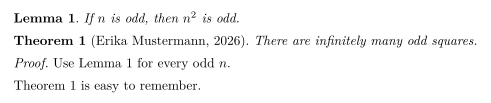
Several kinds of statements
Declare as many kinds as you need: theorem, lemma, proposition, corollary, definition, remark, example. Each kind has its own counter in Scissor LaTeX.
Definition, proposition and remark
\documentclass{article}
\usepackage{amsmath,amsthm}
\newtheorem{definition}{Definition}
\newtheorem{proposition}{Proposition}
\newtheorem{remark}{Remark}
\begin{document}
\begin{definition}[Even number]
An integer $n$ is \emph{even} if $n = 2k$ for an integer $k$.
\end{definition}
\begin{proposition}
The number 44 is even.
\end{proposition}
\begin{remark}
Zero is even as well.
\end{remark}
\end{document}
Unnumbered theorems
\newtheorem* (from amsthm) declares a kind without a number.
An unnumbered statement with \newtheorem*
\documentclass{article}
\usepackage{amsmath,amsthm}
\newtheorem*{conjecture}{Conjecture}
\begin{document}
\begin{conjecture}
Every even number greater than 2 is the sum of two primes.
\end{conjecture}
\end{document}
Numbering and styles
In a TeX installation, \newtheorem has two optional arguments for numbering, and amsthm has \theoremstyle. Here is what Scissor LaTeX does with them:
| You write | TeX installation | Scissor LaTeX |
|---|---|---|
\newtheorem{theorem}{Theorem} | Theorem 1, 2, 3 | Works |
\newtheorem{theorem}{Theorem}[section] | Theorem 1.1, 1.2, 2.1 | Theorem 1, 2, 3: the section part is ignored |
\newtheorem{lemma}[theorem]{Lemma} | Lemma shares the theorem counter | Lemma has its own counter |
\newtheorem*{remark}{Remark} | no number | Works |
\theoremstyle{definition}, {remark} | upright body | Ignored: every body is italic |
\begin{proof} | "Proof." and a square | Works |
\begin{proof}[Proof of Theorem 1] | your own heading | "Proof.": your heading is ignored |
\qedhere | square on the last line of a display | Not supported: that formula is red |
[section] and a shared counter: each kind counts by itself
\documentclass{article}
\usepackage{amsmath,amsthm}
\newtheorem{theorem}{Theorem}[section]
\newtheorem{lemma}[theorem]{Lemma}
\begin{document}
\section{Results}
\begin{lemma} A first lemma. \end{lemma}
\begin{theorem} A first theorem. \end{theorem}
\begin{lemma} A second lemma. \end{lemma}
\end{document}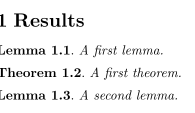
In a TeX installation this example prints Lemma 1.1, Theorem 1.2 and Lemma 1.3. Scissor LaTeX prints Lemma 1, Theorem 1 and Lemma 2.
Without \newtheorem
Many documents copied from elsewhere use theorem, lemma or definition without declaring them. Scissor LaTeX recognises common names anyway, including theorem, lemma, proposition, corollary, definition, remark, example, conjecture, claim, exercise, problem, solution and short forms such as thm, lem and defn.
What differs from a TeX installation
More on the package on the amsthm page. The full manual of the package is at ctan.org/pkg/amsthm.
See also amsthm, Cross-references and cleveref.
Questions and answers
How do I define a theorem environment in LaTeX?
Write \newtheorem{theorem}{Theorem} in the preamble, with \usepackage{amsthm}. Then use \begin{theorem} ... \end{theorem}.
How do I get the QED square at the end of a proof?
Use the proof environment from amsthm. The square is added at the end automatically.
How do I number lemmas and theorems together?
In a TeX installation, write \newtheorem{lemma}[theorem]{Lemma}. Scissor LaTeX does not share counters yet, so lemmas and theorems are numbered separately here.
Every example on this page is typeset by Scissor LaTeX when the site is built. Last updated 2026-11-06.