


amsthm in Scissor LaTeX
The amsthm package works partly in Scissor LaTeX: \newtheorem, the starred \newtheorem*, optional notes such as [Mustermann] and the proof environment work, while \theoremstyle, shared or per-section counters, proof titles and \qedhere are not applied.
What the package does
amsthm lets you declare theorem-like environments with \newtheorem and gives you a proof environment that ends with a small square. Theorem styles (plain, definition, remark) change how the heading and body look.
What works here
| Command | In Scissor LaTeX | Notes |
|---|---|---|
\newtheorem{name}{Title} | Works | Each name gets its own counter: 1, 2, 3. |
\newtheorem{name}[other]{Title} | Partly | The shared counter is ignored; the environment counts on its own. |
\newtheorem{name}{Title}[section] | Partly | Numbers are not reset per section and do not read 2.1. |
\newtheorem*{name}{Title} | Works | No number. |
\begin{theorem}[note] | Works | The note appears in brackets after the number. |
\theoremstyle{...} | Left out | Every environment has a bold heading and an italic body. |
proof | Partly | Always headed "Proof."; an optional title such as [Proof of Lemma 2] is ignored. Ends with a square. |
\qedhere | Not supported | The formula that contains it is shown in red. |
\qed, \qedsymbol | Not supported | Skipped with a Problems note; the proof square comes from the proof environment only. |
Examples
Declare the environments in the preamble, then use them in the text:
\newtheorem, a note and a proof
\documentclass{article}
\usepackage{amsthm}
\newtheorem{theorem}{Theorem}
\newtheorem{lemma}{Lemma}
\begin{document}
\begin{lemma}
Every even number greater than 2 is the sum of two odd numbers.
\end{lemma}
\begin{theorem}[Mustermann]
The number 44 is the sum of two primes.
\end{theorem}
\begin{proof}
Take $44 = 3 + 41$, and both 3 and 41 are prime.
\end{proof}
\end{document}
An unnumbered environment with \newtheorem*. The \theoremstyle{definition} line is accepted, but the body stays in italics:
\newtheorem* and \theoremstyle
\documentclass{article}
\usepackage{amsthm}
\theoremstyle{definition}
\newtheorem{definition}{Definition}
\newtheorem*{remark}{Remark}
\begin{document}
\begin{definition}
A number is \emph{even} if it is divisible by 2.
\end{definition}
\begin{remark}
By this definition, 0 and 44 are even.
\end{remark}
\end{document}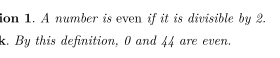
\qedhere moves the square into a display formula at the end of a proof. It is not known here, so the formula turns red:
\qedhere shows a red formula
\begin{proof}
It remains to compute
\[ 44 = 4 \cdot 11. \qedhere \]
\end{proof}
Shown in red: the formula cannot be read, so its source is shown instead.
Leave \qedhere out. The square then sits on its own line after the formula, which is also correct:
The same proof without \qedhere
\begin{proof}
It remains to compute
\[ 44 = 4 \cdot 11. \]
\end{proof}Compatibility
- From a TeX installation to here: documents typeset. Numbers can differ when environments share a counter, and every theorem style looks like
plain. Remove\qedherewhere a formula turns red. - From here to a TeX installation: documents compile there unchanged, as long as every environment is declared with
\newtheorem.
The full manual is on CTAN: ctan.org/pkg/amsthm. For a guided introduction, see Theorems and proofs.
See also Theorems and proofs and cleveref.
Questions and answers
Why do my lemmas and theorems not share one counter?
Scissor LaTeX gives each environment its own counter and ignores the [theorem] argument. Your document still compiles; only the numbers differ from a TeX installation.
Can I change the proof heading?
Not yet. The optional argument of proof is ignored and the heading is always "Proof.". You can write the title as the first words of the proof instead.
Every example on this page is typeset by Scissor LaTeX when the site is built. Last updated 2026-11-06.