


ACM LaTeX template (acmart sigconf)
The official ACM template is the acmart class, from CTAN or ACM's proceedings template page. Scissor LaTeX has a free look-alike of its sigconf format for drafting in your browser, with no account: start from the ACM template, or write \documentclass[sigconf]{acmart}, and two-column pages with CCS concepts and keywords appear as you type. The same .tex compiles with the official class.
Open the ACM template in the editor Free, in your browser, no account
The template
The ACM template is a systems paper about batching requests in a key-value store, with three authors, CCS concepts, a latency chart, a booktabs table, an acknowledgements section and numbered references. Open the ACM template in the editor to see all of it.
Turning it on
acmart is a document class, and the format is its option:
\documentclass[sigconf]{acmart}The layout is Letter paper, two columns at 9 pt, with Libertinus as a free substitute for the Libertine fonts of acmart (downloaded the first time a document needs them, about 2.7 MB). The journal formats acmsmall, acmlarge, acmtog and manuscript (also the default when no format is given) use the ACM journal layout. Other proceedings formats such as sigplan keep all the commands below, but are drawn with the sigconf look in one column at 10 pt, with a note in the Problems tab.
Order of the front matter
In acmart, the abstract, the CCS concepts and the keywords come before \maketitle: put the abstract after \begin{document} and before \maketitle, as the official sample does. Scissor LaTeX prints them after the title and the authors, as the class does.
Authors, abstract, CCS concepts and keywords
\documentclass[sigconf]{acmart}
\setcopyright{none}
\acmConference[EXCS '26]{Example Conference on Computer Systems}{June 1--4, 2026}{Example City}

\title{Tail-Latency-Aware Request Batching}

\author{Erika Mustermann}
\affiliation{%
  \institution{Example University}
  \city{Musterstadt}
  \country{Germany}}
\email{erika.mustermann@example.org}

\author{John Doe}
\affiliation{%
  \institution{Institute of Example Studies}
  \city{Exampleton}
  \country{USA}}
\email{john.doe@example.org}

\begin{document}
\begin{abstract}
Batching requests raises throughput but hurts the slowest requests. We size batches
from the observed queue so that the 99th percentile latency stays within a budget.
\end{abstract}

\ccsdesc[500]{Information systems~Key-value stores}
\ccsdesc[300]{Computer systems organization~Distributed architectures}
\keywords{request batching, tail latency, key-value stores}
\maketitle

\section{Introduction}
A key-value store serving 44 clients spends much of its time on per-request overhead.
\end{document}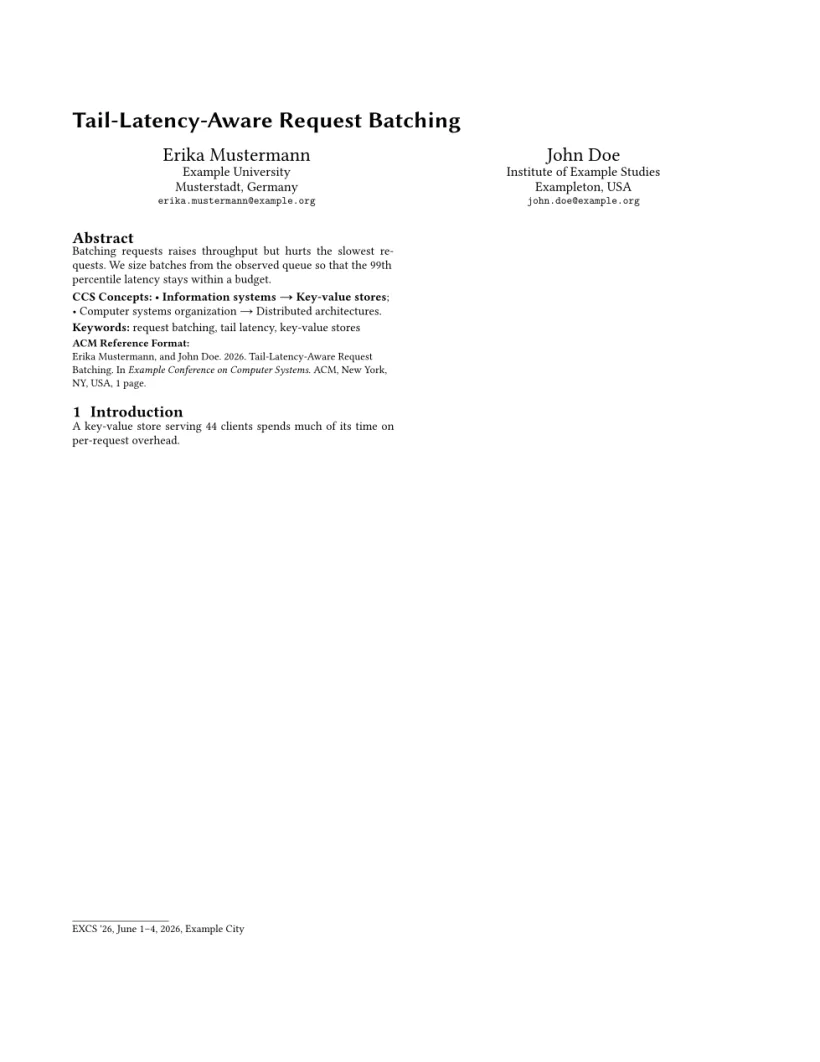
Problems tab: Layout in the style of the ACM sigconf format (final mode). Not official. To compile elsewhere, add acmart.cls from ctan.org/pkg/acmart.
Modes
| Class options | Authors | Line numbers | Page numbers |
|---|---|---|---|
[sigconf] | shown | no | no |
[sigconf,review] | shown | yes | yes |
[sigconf,anonymous] | "Anonymous Author(s)" | no | no |
[sigconf,review,anonymous] | "Anonymous Author(s)" | yes | yes |
[sigconf,nonacm] | shown, without the venue and reference format blocks | no | no |
review and anonymous are independent, as in acmart. Most double-blind venues ask for both.
Class commands
| Command | What it does | In Scissor LaTeX |
|---|---|---|
\author, repeated | one author each | Works |
\affiliation{\institution{..}\city{..}\country{..}} | the affiliation of the last author; also \department, \streetaddress, \state, \postcode | Works |
\email, \additionalaffiliation, \authornote | more author details | Work |
\orcid | an ORCID iD | Accepted, not shown |
\ccsdesc[weight]{A~B} | a CCS concept; weight 500 and above is bold | Works |
\keywords{..} | the keyword line | Works |
\acmConference[short]{name}{date}{place}, \acmBooktitle, \acmYear, \copyrightyear, \acmDOI, \acmISBN | venue and publication data | Work: used in the venue lines, the running heads and the "ACM Reference Format" block |
\setcopyright{..} | the rights statement | The venue lines are printed; the ACM permission text itself is never printed |
\settopmatter{printacmref=false} | no reference format block | Works; printfolios=true adds page numbers |
\renewcommand{\shortauthors}{..} | the author names in the running head | Works |
\subtitle{..} | a subtitle | Works |
teaserfigure environment | a full-width figure under the authors | Partly: shown at full width, but above the title instead of under the authors |
acks environment | an unnumbered "Acknowledgments" section | Works |
CCSXML, \Description{..}, \received, \citestyle | metadata | Accepted and ignored |
Bibliography
The template uses \bibliographystyle{ACM-Reference-Format}, which Scissor LaTeX sets as numbered references. See bibliographies.
What differs from acmart
To submit, get acmart from CTAN (acmart), where the full class manual is too, or from ACM's proceedings template page. Your .tex file compiles with it unchanged. See conference look-alike templates for the other layouts.
Questions and answers
How do I make an anonymous ACM submission?
Use \documentclass[sigconf,review,anonymous]{acmart}. The authors are replaced by "Anonymous Author(s)", and line and page numbers are added.
Why does the abstract come before \maketitle in ACM papers?
That is how acmart collects the front matter: the abstract, CCS concepts and keywords are read first and then printed by \maketitle in the right place. Scissor LaTeX follows the same order.
Can I use acmsmall or the journal formats?
Yes. acmsmall, acmlarge, acmtog and manuscript get the one-column ACM journal layout; there is an ACM journal template in the editor's Journals tab. See journal look-alike templates.
Every example on this page is typeset by Scissor LaTeX when the site is built. Last updated 2026-11-06.