


ICML 2026 LaTeX template (icml2026.sty)
ICML papers use the icml2026.sty kit from the author instructions at icml.cc. Scissor LaTeX has a free look-alike for drafting in your browser, with no account: start from the ICML template, or load \usepackage{icml2026} in an article and write the title block inside \twocolumn[..], and two-column pages appear as you type. The same .tex compiles with the official kit.
Open the ICML template in the editor Free, in your browser, no account
The template
The ICML template is an optimisation paper about min-max problems, with three authors (two marked as equal contributors), a theorem, a log-scale chart, a booktabs table, cleveref references and author-year citations. Open the ICML template in the editor to see all of it. It starts in preprint mode.
Turning it on
The kit is a package on a plain article:
\documentclass{article}
\usepackage{icml2026}
The year is read from the package name (icml2025, icml2027 ...). The page is always Letter and two columns, set in TeX Gyre Termes, a free Times substitute.
Modes
| Line | Mode | Authors | Line numbers | Notice in the affiliations box |
|---|---|---|---|---|
\usepackage{icml2026} | submission | "Anonymous Authors" | yes | "Preliminary work. Under review ..." |
\usepackage[preprint]{icml2026} | preprint | shown | no | "Preprint." |
\usepackage[accepted]{icml2026} | camera-ready | shown | no | the proceedings line with the year |
Page numbers are centred at the foot of every page, and the running title is at the top of the pages after the first.
The title block
ICML papers put the title and the authors in a \twocolumn[..] block, so they span both columns. Each author lists keys for their affiliations and marks; the affiliations box at the foot of the first column is printed by \printAffiliationsAndNotice, which the kit requires even when it is empty (\printAffiliationsAndNotice{}).
Author list, equal contribution and the affiliations box (preprint mode)
\documentclass{article}
\usepackage[preprint]{icml2026}
\usepackage{amsmath}

\icmltitlerunning{Variance-Reduced Extragradient}

\begin{document}
\twocolumn[
  \icmltitle{Variance-Reduced Extragradient for Smooth Min-Max Problems}
  \icmlsetsymbol{equal}{*}
  \begin{icmlauthorlist}
    \icmlauthor{Erika Mustermann}{equal,eu}
    \icmlauthor{Hans Mustermann}{equal,ies}
    \icmlauthor{John Doe}{eu}
  \end{icmlauthorlist}
  \icmlaffiliation{eu}{Department of Computer Science, Example University, Musterstadt, Germany}
  \icmlaffiliation{ies}{Institute of Example Studies, Exampleton, USA}
  \icmlcorrespondingauthor{Erika Mustermann}{erika.mustermann@example.org}
  \vskip 0.3in
]
\printAffiliationsAndNotice{\icmlEqualContribution}

\begin{abstract}
We combine extragradient steps with variance reduction and reach a duality gap of
$10^{-6}$ with fewer gradient evaluations on problems of size 44 to 4,400.
\end{abstract}

\section{Introduction}
Many training problems are saddle-point problems $\min_x \max_y f(x, y)$.
\end{document}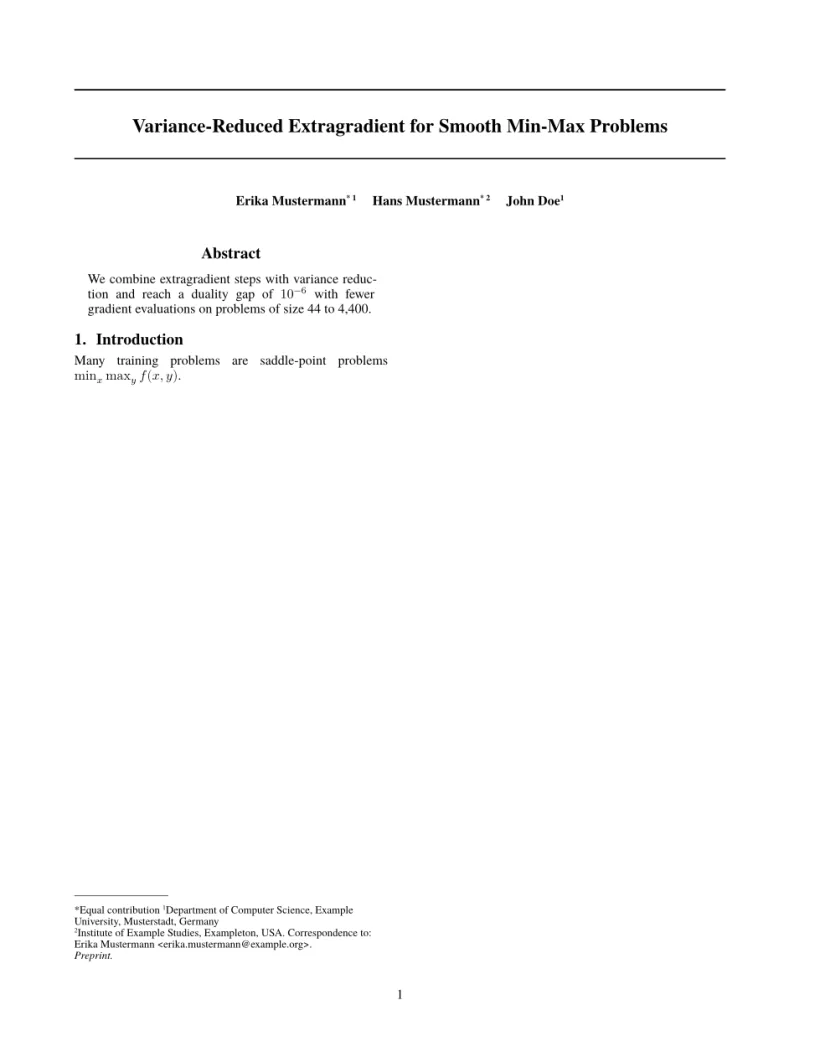
Problems tab: Layout in the style of the ICML style (preprint mode). Not official. To compile elsewhere, add the ICML style files from icml.cc.
Kit commands
| Command | What it does | In Scissor LaTeX |
|---|---|---|
\twocolumn[..] | the full-width title area | Works: the content is placed across both columns |
\icmltitle{..} | the title between two rules | Works |
icmlauthorlist, \icmlauthor{name}{keys} | the author names with superscript marks | Work; affiliations are numbered in order of first use |
\icmlsetsymbol{equal}{*} | a key shown as a symbol, such as equal contribution | Works |
\icmlaffiliation{key}{text} | the text of an affiliation | Works |
\icmlcorrespondingauthor{name}{email} | the "Correspondence to" line | Works |
\printAffiliationsAndNotice{..} | the affiliations box with the mode notice | Works; \icmlEqualContribution adds "*Equal contribution" |
\icmltitlerunning{..} | the running title | Works |
\icmlkeywords{..} | keywords for the PDF metadata | Accepted, not printed (as in the kit) |
algorithm, algorithmic (\STATE, \FOR, \IF ...) | pseudocode | Partly: one line per statement with bold keywords and an "Algorithm 1." caption, but each line is centred in the column, so the nesting is hard to read |
Bibliography
The template uses \bibliographystyle{icml2026}, which Scissor LaTeX sets as author-year citations ("Doe et al., 2026") with \citet and \citep. See bibliographies and algorithms.
What differs from icml2026.sty
To submit, get the kit (icml2026.sty and icml2026.bst) from the author instructions at icml.cc and put the files next to your .tex file; it compiles unchanged. See conference look-alike templates for the other layouts.
Questions and answers
Why does an ICML paper use \twocolumn[...]?
The kit sets the whole paper in two columns, and the title and authors must span both. Everything in the brackets of \twocolumn[..] goes across the full width; Scissor LaTeX does the same.
How do I mark equal contribution in ICML?
Define a symbol with \icmlsetsymbol{equal}{*}, add equal to the keys of those authors, and pass \icmlEqualContribution to \printAffiliationsAndNotice.
How do I switch to the camera-ready version?
Write \usepackage[accepted]{icml2026}. The authors appear and the notice becomes the proceedings line.
Every example on this page is typeset by Scissor LaTeX when the site is built. Last updated 2026-11-06.