


CVPR LaTeX template (pati ICCV at WACV)
Nasa github.com/cvpr-org/author-kit ang opisyal na CVPR author kit. May libreng kahawig nito ang Scissor LaTeX para sa pag-draft sa browser mo, nang walang account: magsimula sa CVPR template, o i-load ang \usepackage[review]{cvpr} sa isang two-column article, para sa review copy na may line numbers at anonymous authors, sa rebuttal o sa camera-ready layout. Nagko-compile ang parehong .tex gamit ang opisyal na kit.
Buksan ang template na CVPR sa editor Libre, sa iyong browser, walang account
Ang template
Ang CVPR template ay computer-vision paper tungkol sa semantic segmentation na may tatlong author, full-width chart na naghahambing ng model families, per-class booktabs table, cleveref references at numbered citations. Buksan ang CVPR template sa editor para makita ang lahat. Nagsisimula ito sa camera-ready layout na may page numbers; magpalit ng isang option para sa review copy.
Pag-on nito
Package ang kit na nakapatong sa two-column article:
\documentclass[10pt,twocolumn,letterpaper]{article}
\usepackage[review]{cvpr}
Ino-on din ng \usepackage{iccv} at \usepackage{wacv} ang parehong layout, dahil iisang kit ang gamit ng tatlong conference. Laging Letter at dalawang column ang pahina, naka-set sa TeX Gyre Termes (isang libreng pamalit sa Times, dina-download sa unang beses).
Mga mode
| Linya | Mode | Authors | Line numbers | Page numbers |
|---|---|---|---|---|
\usepackage[review]{cvpr} | review copy | nakatago | oo, sa dalawang panlabas na margin | oo |
\usepackage{cvpr} | camera-ready | ipinapakita | hindi | hindi |
\usepackage[pagenumbers]{cvpr} | camera-ready, halimbawa para sa arXiv | ipinapakita | hindi | oo |
\usepackage[rebuttal]{cvpr} | isang-pahinang rebuttal | nakatago | oo | oo |
Sa review mode, pinapalitan ang authors ng "Anonymous CVPR submission" at ng paper ID, at may header sa itaas ng bawat pahina na may pangalan ng conference, taon, paper ID at "CONFIDENTIAL REVIEW COPY". Itakda ang ID gamit ang \def\paperID{..}; hangga't wala, mga bituin ang ipinapakita. Nagbibigay pa rin ng camera-ready mode ang lumang switch na \cvprfinalcopy mula sa mas lumang kits.
Review copy: anonymous, may line numbers
\documentclass[10pt,twocolumn,letterpaper]{article}
\usepackage[review]{cvpr}
\usepackage{amsmath}

\def\paperID{44}
\def\confName{CVPR}
\def\confYear{2026}

\title{Boundary-Aware Refinement for Lightweight Segmentation}
\author{Erika Mustermann\\
Example University\\
{\tt\small erika.mustermann@example.org}
\and
John Doe\\
Institute of Example Studies\\
{\tt\small john.doe@example.org}}

\begin{document}
\maketitle

\begin{abstract}
Small segmentation networks blur object boundaries. We add a refinement head that
works on a thin band around predicted edges and costs little extra computation.
\end{abstract}

\section{Introduction}
\label{sec:intro}
Lightweight models are fast but lose detail at boundaries, where most errors occur.
On 44 classes, the band covers less than a tenth of the pixels.
\end{document}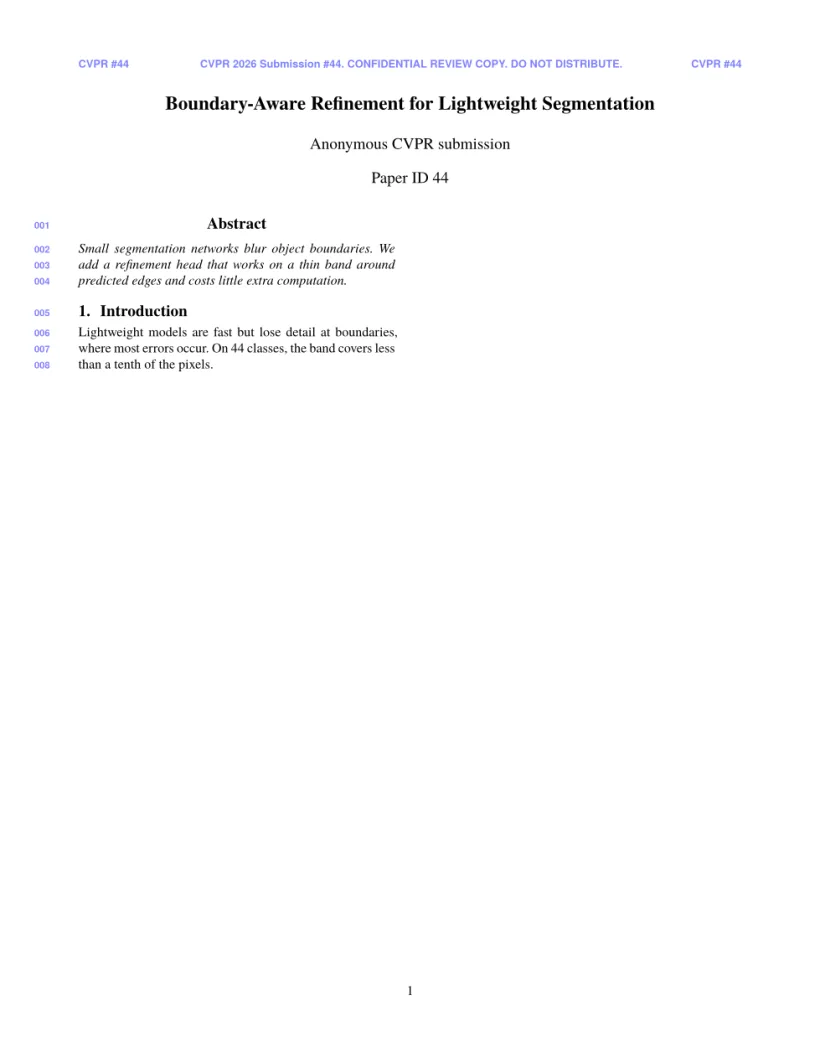
Tab na Problems: Layout in the style of the CVPR author kit (anonymous review mode). Not official. To compile elsewhere, add cvpr.sty from github.com/cvpr-org/author-kit.
Mga command ng kit
| Command | Ano ang ginagawa nito | Sa Scissor LaTeX |
|---|---|---|
\def\confName{CVPR}, \def\confYear{2026} | ang pangalan at taon ng conference sa review notices | Gumagana; palitan para sa ICCV o WACV |
\def\paperID{..} | ang paper ID mo sa review copy | Gumagana: ipinapakita sa ilalim ng title at sa header |
{\tt\small ..} sa \author | e-mail line sa ilalim ng pangalan | Gumagana |
\and | ang susunod na author | Gumagana |
strip environment (cuted) | full-width na nilalaman sa two-column page | Gumagana |
\maketitlesupplementary | ang title block ng supplementary material, walang authors | Gumagana |
\cvprfinalcopy, \def\cvprPaperID{..} | ang camera-ready switch at paper ID ng mas lumang kits | Gumagana: camera-ready mode, at ang paper ID gaya ng nasa itaas |
Gamit ang \usepackage[colorlinks, ..]{hyperref}, gaya ng nasa template, kinukulayan ng cvprblue ng kit ang links, references at citations. Nagbibigay ang \cref at \Cref mula sa cleveref ng "Sec. 1" at "Tab. 1" gamit ang \crefname lines ng template.
Bibliography
Gumagamit ang template ng \bibliographystyle{ieeenat_fullname}, na sine-set ng Scissor LaTeX bilang numbered references. Tingnan ang mga bibliography.
Ang naiiba sa cvpr.sty
Para mag-submit, kunin ang kit mula sa github.com/cvpr-org/author-kit at ilagay ang mga file nito sa tabi ng .tex file mo; magko-compile ito nang walang binabago. Tingnan ang mga template na kahawig ng sa conference para sa ibang layouts, at ang floats para sa figure*.
Mga tanong at sagot
Paano ako lilipat mula sa review copy papunta sa camera-ready paper?
Palitan ang \usepackage[review]{cvpr} ng \usepackage{cvpr}, o ng \usepackage[pagenumbers]{cvpr} kung gusto mo rin ng page numbers. Agad na nag-a-update ang preview.
Puwede ko bang gamitin ang template na ito para sa ICCV o WACV?
Oo. Isulat ang \usepackage[review]{iccv} o \usepackage[review]{wacv} at itakda ang \confName at \confYear; pareho ang layout.
Ito ba ang opisyal na CVPR template?
Hindi. Kahawig ito para sa pag-draft. Gamitin ang opisyal na author kit para sa submission; gumagana rito ang .tex file mo nang walang binabago.
Bawat halimbawa sa page na ito ay tina-typeset ng Scissor LaTeX kapag binubuo ang site. Huling na-update noong 2026-11-07.